A leader is one who can do the things others can do.
A leader is one who has experienced a similar, if not exactly the same, things others have experienced.
A leader is one who educates through example.
One cannot lead if one does not understand what the experience is.
One cannot lead if one is put in a dark space without having been there before.
One cannot lead if one does not see the potential in others for good.
To explore is to be given options.
To have those options taken away reduces the ability to explore.
This applies to both the leader as well as the one/s who follow/s.
A leader is one who asks, ‘Would you like to try this?’ The leader asks in an open and honest way.
Once again, to be given the option to lead correctly, the leader must be able to understand who, or what, or if, they are leading through choice, or through the lack of it.
If they have not been given a choice, the leader may not wish to lead at all.
If I was thrown into a dark space, and did not know who I was surrounded by or if I was surrounded by anyone, then the only choice I would have remaining is to look after myself first: I do not know my surroundings. I do not know if I have enemies or friends in this space. I must try to get out of this space, to a space where I can see.
Where is this space?
What are the rules of this space?
Am I informed in such a way that I completely understand the rules of this space?
Am I given options?
Do I have a right to maintain my own privacy, or is that right continuously taken away?
Is this a prison?
These are the questions anyone will ask themselves if put in such a space.
If one is not given a clear and concise option, one will not lead others. One will not follow others. One will withdraw into a space within that space and only look after oneself. One will, after a time, begin to lash out at anything or anyone infringing on that space because one was not given options.
This is not about language barriers. This is about not being given choices. This is about others infringing on one’s personal space and saying to themselves, ‘I like this space, I will come here.’ The choice of leading by example is taken away. The choice of educating or teaching is taken away. One now does not have a choice. Therefore, one does not lead.
To be mutable is to be able to adapt to one’s surroundings. If one does not know what one’s surroundings are, or why one is there, the ability to be mutable is taken away. One becomes angry, frustrated and one refuses to continue.
The human companion has written on my behalf many times over the years and I can safely inform you she isn’t getting any better at it. As I am a cat though, I can’t complain. I can only bite her viciously occasionally and maybe rabbit-kick her with my rear legs.
It has been several years (and I do allow her to write several because I can’t count and she can’t remember) since I joined this small pride of people, and they seem to be learning absolutely nothing from me at all. Instead, I am ridiculed for my continued lack of masculinity (I believe the tag formerly used was #nonuts) and, I am still not allowed within the confines of the younger men’s room as they do not like it when I wish to conduct one-cat scouting parties for feral beasts and spare food.
It is beyond preposterous.
Yesterday evening, the human companion (whom some may call the people mama although it is not very often I see her acting in a motherly way) attacked me with something resembling a feather duster. I use the descriptive words of feather and duster together simply so people understand what it was she was attacking me with. It is not quite the correct term, as there are no feathers on it, merely some form of cotton/acrylic blend atrocity that serves the purpose of dusting when it is not being used to provoke me.
The damn thing has an extendable arm, which she (the human companion) has become rather adept at extending. I would call fowl play but as I said it has no feathers, therefore I shall use the term foul play instead, which, as I am being informed by the human companion, is exactly the right term to use – not that I particularly care what she says, because she doesn’t even know how to catch a mouse. She chose to poke me with the duster for several (please refer to the former comment on several, which usually means somewhere between five and ten but here refers to “we are not sure”) minutes after my most recent attempt at deconstructing her forearm (and sections of her upper arm as well).
As a cat, I will state here that my attempt at human arm deconstruction was for a very damn good reason, and I shall lay that reason out below.
The human companion sat down next to me.
I know, right? I do not remember giving her permission to do that. Then, the horrible creature decided to pat my beautiful fur and say hello.
The nerve of this interaction has simply upset me all over again. While I lay here in the bedroom this morning at the foot of the “Father Figure” I am tempted to attack said foot just to make up for the rudeness of his feminine partner. Unfortunately for me, I know I would be then rudely ejected from the bedroom with… Okay, I am exaggerating. The Father Figure only rudely ejects me from the bedroom when I have performed extreme and repeated manoeuvres with the vertical blinds at the front window. I may simply bite the Father Figure’s foot gently through the doona. I will not use claws, as this can be felt through the doona (it is a light, summer doona), but will bite hard enough that the light pressure (and, as one can tell I am using light as a term lightly) of my teeth will be felt and probably ignored unless I do it again.
My human companion has been enjoying herself far too much writing this update on my life, so I am going now. The rising of the sun has lightened the sky from its former darkness to a colour I cannot describe as a cat, and it is time for me to go to sleep.
Sincerely,
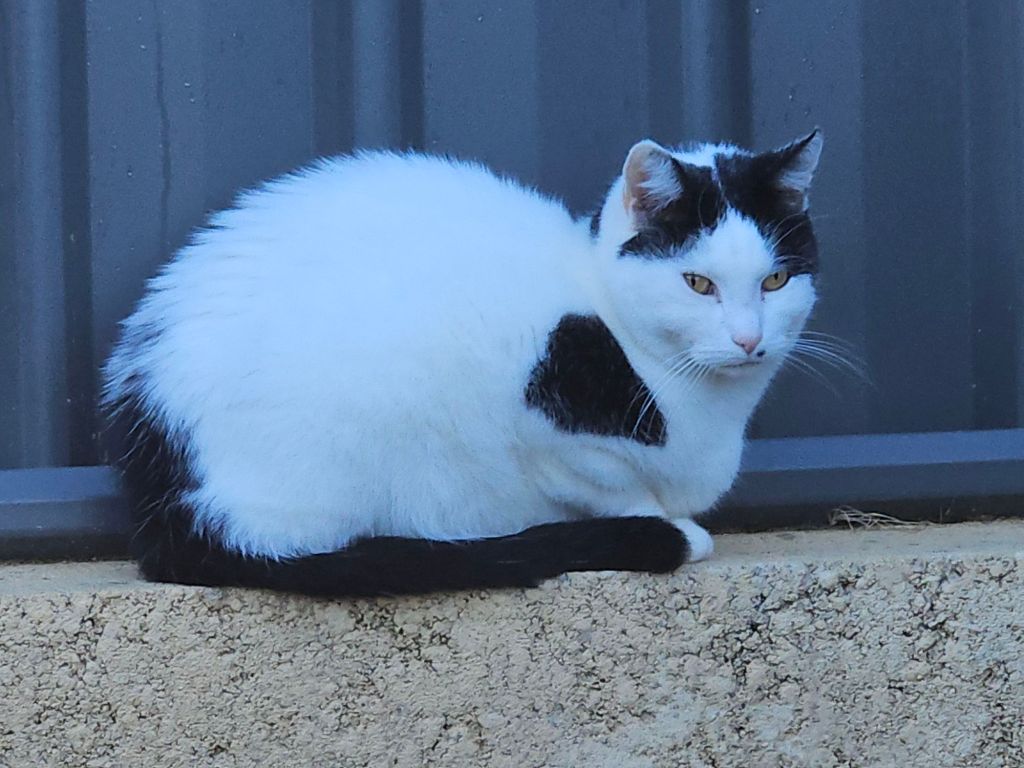
Jodh, AKA leChat AKA #nonuts #thatsmycat AKA many other names I have been called by the bloody woman who writes about me. Pfft.
**This is a picture of me, taken this morning. I am waiting patiently for my neighbour, el Cato, to jump onto the fence so I can surprise him.
The story of “The Horseshoe” was based around a Dreamtime story that had quite a lot of truth in it.
At Hyden in Western Australia there is a cave. The people know the story of the man who lived in this cave, and what happened to him. One would have to travel to Hyden to hear this story properly, but I can give you the basics.
Mulka had been born with crossed eyes and because of this he could not hunt. He was a very tall man. His mother would take food to him in the cave where he lived, but he would get hungry. He ended up stealing the little kids to eat. When the men of the tribe found this out they chased him for a very long time before finally catching him in another place, which was a long way from where the cave was. They speared him until he was dead, and left him on an ant hill to be eaten by the ants, as he was not a good man and did not deserve to be treated properly.
In The Horseshoe, a story I had written and lost, a family moved to a small town from the city and bought a farm. The mother eventually passed away from cancer, but before she did, she had begun exploring the similarities of her British culture with that of the local people, one of whom was an indigenous nurse. The two women believed the area near which the man had been speared many, many years before was quite close to the farm, and the curse the men had placed on the man all those years before had been broken by someone who had not understood the dangers.
Between them, the two women tried to find things to stop the curse from recurring, but it was not something they could do. Eventually, the mother passed away, but she had left copious notes on what they were looking for.
This passing left the father and the two adult children to look after themselves. The father had not understood what their offspring’s mother had been looking for, and had dismissed it as a myth, but he had still let her do it because it “kept her entertained”. (The fact he had “allowed” it was something that might make many people very angry, as it seems to some that he had a choice in the matter. He did not.)
It was left to the son to collect his mother’s belongings from the local hospital, where he met the woman who had been researching with his mother. She had cared for his mother during her latest hospital stay, and understood the emotional pain he was experiencing from his mother’s loss. What he, the son, did not understand was the special bond between his mother and the lady who had cared for her.
The young man had spent many hours, days and months on the farm looking for iron, because that was what his mother had wanted hanging (literally) around the house, but he did not know that the bad spirit (who remained unnamed in the story) was not worried by things like iron, and wanted to take his sister away from him too.
Innately, he knew something was very wrong, but would not listen to the nurse, and she had to endure many misunderstandings from him before finally convincing him they had to see the elders, who were men and knew what to do. I will add here that this is a very important part of the story, because it was the warriors of the people who had chased the bad man and killed him, so it was up to them to make sure the area he had died in was undisturbed or his bones were thrown away in a place they would never be found again. (perhaps they decided between the two peoples there was a solution because more modern technology was available). This is where the shared knowledge of “smoking” to clear the air of bad spirits is shared amongst many cultures.
Throughout the story we learn of the differences between cultures, even those cultures that may seem the same but are on different sides of the country and have different beliefs in the signs of the birds and animals. As an example I used the curlew and the willy-wagtail.
Also throughout the story, we learn of how listening and learning helps us understand what it is to be local to an area, and how to integrate as someone new to the area. It helps to understand what has happened there, and what can be done to make it more tolerable between different people – to find things they have in common, rather than things they have that are different.
This was the story of The Horseshoe.
C.S. Capewell nee Tew.
Postscript:. Within the story I told of “The Horseshoe”, two women from different backgrounds worked together openly to understand each other. It is one of the “morals of the story” in some respects, especially if people do not understand the difference between friendship and romantic interaction. There is a vast difference between these two things and it is sad that many do not understand this until they are older, wiser, or perhaps even both.
The young man’s journey through this story reflects how he comes to terms with dealing with things he has no real understanding of, by choosing to listen or read instead of talking. This is how, at the end of the story, he becomes better at dealing with people in general and opens himself up more to being loved for who he is, rather than who he (or others) thinks he should be.
Everyone is different, but we do have things in common. It is up to us to decide whether we will listen and learn, follow or be followed, agree or disagree. One does not need to be in a spotlight to influence, and often when one is in a spotlight, they are ridiculed for their opinion (because, apparently, they can’t have one). But, if one chooses to research as much as they are able and still come out the other side with decency, respect and the ability to be courteous of others in an open, unhidden, situation rather than using insidious threats and hidden agendas, then that is the time one can say “I understand”.
I take this onboard for myself as much as for anyone who reads this in the future. Self-honesty is very important to have. Therefore, if I feel the need to edit, or change, that is my prerogative, not someone else’s. If I feel the need to work with someone else to see problems I can’t see, that is also my prerogative.. If I choose to expand on a point to make someone else understand my point of view, that is my prerogative, and if I choose to make something more marketable to work within a certain industry or “niche” that is also my prerogative – not anyone else’s.
To understand something or someone is not going to be available in a one line quote.


 Kate Capewell - Ambrosia Wishes